
The aim of SDG 13
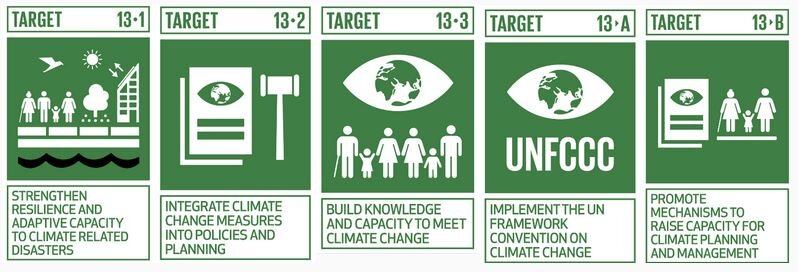
The aim of SDG 13 Climate Action is to take urgent action to combat climate change and its impacts, strengthening resilience and adaptive capacity. It requires emissions reductions, climate risk management, and adaptation across sectors.
Further resources
The website of the United Nations gives more insights into this SDG, its targets and indicators as well as its worlwide progress.
The website of the Global Goals also gives more information on the single targets, but also on possible actions, and further resources.
The Climate Action Tracker is an independent scientific project that monitors government climate action and assesses whether actions are on track to meet the Paris Agreement goals of limiting warming to 1.5–2°C. It combines country-level pledges, policies, and actions to quantify progress and project likely temperature outcomes, providing up-to-date, policy-relevant assessments for policymakers and the public.
The Climate Action Network (CAN) is a global CSO network that coordinates civil society action on climate at the UN climate talks and other international forums, advocating for ambitious Paris Agreement targets and climate justice. It centers affected communities’ voices, pushes for fossil fuel phase-out, and works to strengthen regional networks to ensure bottom-up, just climate action.
Connection to tourism
Tourism contributes to emissions reduction through cleaner transport, energy efficiency, and climate-smart planning. Adaptation and resilience measures help destinations cope with climate impacts on infrastructure and livelihoods. Travel demand can fund climate resilience projects and adaptation programs. Collaboration to share best practices accelerates progress.
Best practices
Plateau Pioneers in Seefeld foster climate action on destination level by uniting ambitious hotels as trailblazers to drastically cut greenhouse gas emissions by 2030 through measurable climate-specific targets and collaborative initiatives. Pioneering hotels like Daschil's Bergland implement resource-saving measures such as sustainable all-inclusive concepts without buffets to halve food waste, photovoltaic systems and district heating for energy efficiency, and chemical-free water revitalization, while sourcing local materials for renovations. Other members, including Hotel Klosterbräu, prioritize regional energy from bio-district heating and solar power, plastic avoidance, heat recovery, and biodiversity projects like the Seefeld Forest & Bee initiative, all coordinated by the regional tourism board to create a scalable model for climate-neutral tourism.
Austrian KLAR! regions support SDG 13 (Climate Action) by implementing targeted measures to adapt to climate change impacts, such as raising awareness, mitigating risks and enhancing regional resilience through process-oriented programs funded by the Austrian Climate and Energy Fund. In Tyrol, concrete projects include the Stanzertal-Arlberg region's expansion of e-mobility, training of hiking guides on climate effects in forests, creation of e-bike tours and sustainability-themed trails, as well as pond renaturation at Nessleralm and youth-led tree sponsorships to preserve species. Another example is the Kaunergrat region's KLAR initiative, which promotes climate-friendly tourism offers via workshops, local stakeholder involvement and a coordinator for sustainable measures across ecological, economic and social dimensions. These initiatives typically involve municipalities, tourism associations, schools, local businesses, regional managements, youth and experts in collaborative workshops and development processes.
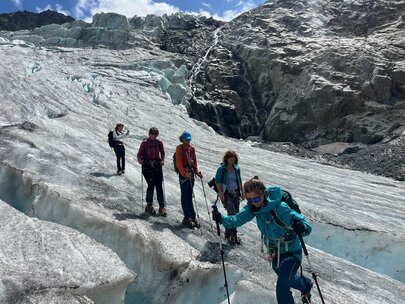
Climate hikes are guided or self-guided hiking trails designed to educate participants about the visible impacts of climate change on natural environments, such as retreating glaciers, changing biodiversity or altered landscapes, while promoting low-emission outdoor activities. Concrete examples include the "Climate Hikes" project by EcoSystem Europe, which combines alpine trekking in the Alps with on-site explanations of warming effects, and Stanzertal-Arlberg KLAR! region's trained hiking guides who lead tours highlighting forest climate stress and sustainability trails in Tyrol. Other offers can be found in the regions of Kaunertal, Alpbachtal or Saalfelden Leogang, Montafon or These initiatives support SDG 13 by raising public awareness of urgent climate action needs, encouraging emission-free recreation over motorized tourism, fostering resilience through nature-based adaptation learning, and extending tourism seasons to reduce peak-season pressures.